ServicesConcrete Courtyards
Concrete Courtyards in Rancho Santa Margarita
A courtyard is boxed in by walls, so every gallon of rain has to leave through a drain you planned for. We grade, form, and pour courtyard slabs that move water away from your home, then come back after the cure to check the work with you.
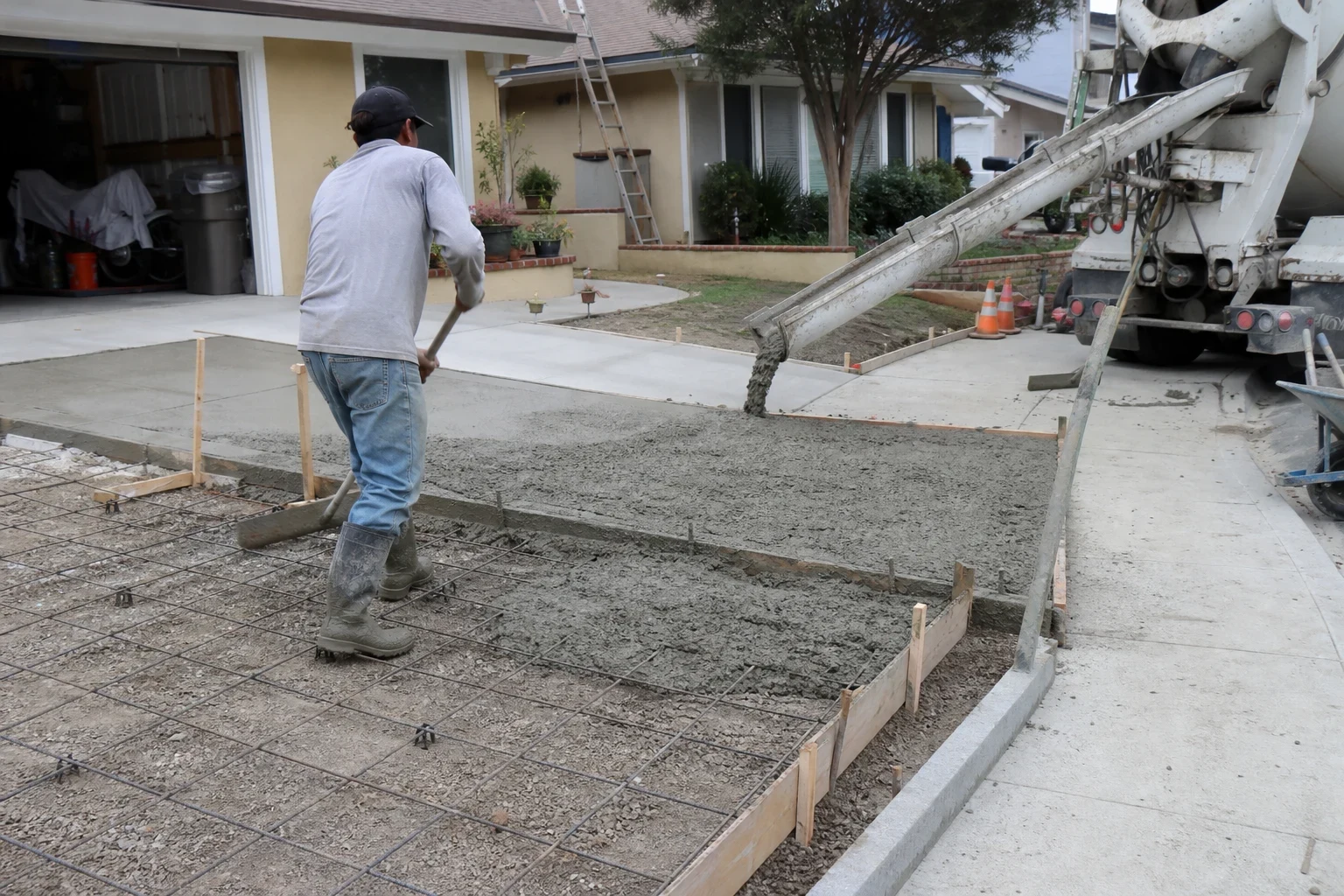
Why a courtyard slab is its own kind of pour
On an open patio, water can sheet off the edge into the lawn. In a courtyard enclosed on three or four sides, it can't. The slab has to fall toward area drains or a channel drain at a steady pitch, usually 1/8 to 1/4 inch per foot, and the finished surface has to sit low enough on the walls that it doesn't bury the stucco weep screed. Get either wrong and water ends up against the foundation or wicking into the wall.
Access is the other difference. Many courtyards can only be reached through a narrow side gate or a passage beside the garage, so we plan how the concrete gets in before we quote it, whether that's a line pump or a wheelbarrow crew. On the Spanish and Mediterranean style homes common here, we also work around tile thresholds, low door sills, and existing planters.
After the pour we don't just pull the forms and leave. We come back once the slab has cured, look at the joints and drainage with you, and walk you through how to care for the surface.
What a courtyard job includes
- Demolition and haul-off
- We break out old pavers, tile, or a worn slab and haul the debris away. Removing the old material lets us see the subgrade instead of pouring over a problem.
- Subgrade and base
- South Orange County clay swells when wet and shrinks when dry. We compact the native soil, then place and compact a layer of Class 2 aggregate base so the slab sits on a stable, even bed.
- Drainage planned into the grade
- We set area drains or a trench drain at the low points and tie them into your existing drain lines where they run to daylight or the street. The forms are shot to grade so the fall is built in, not guessed at.
- Reinforcement and joints
- Rebar on chairs keeps the steel in the middle of the slab where it does its job. Control joints are cut or tooled at spacing matched to slab thickness, and expansion material separates the slab from walls, steps, and columns.
- Finish of your choice
- Broom, light sand, and salt finishes give good footing. Integral color or a stamped pattern is also an option; our Stamped Concrete page covers those details.
Signs your courtyard needs a new slab
Water pools after rain
Puddles that sit for hours mean the surface has lost its fall or never had one. In an enclosed space, standing water has nowhere else to go.
Damp or stained stucco at the base
Efflorescence or dark staining along the bottom of the walls often means the paving sits too high or slopes toward the house.
Pavers heaving or sinking
When the sand bed washes out or roots push up, pavers rock and trip people. A monolithic slab on a compacted base removes the loose joints.
Cracked tile or an aging slab
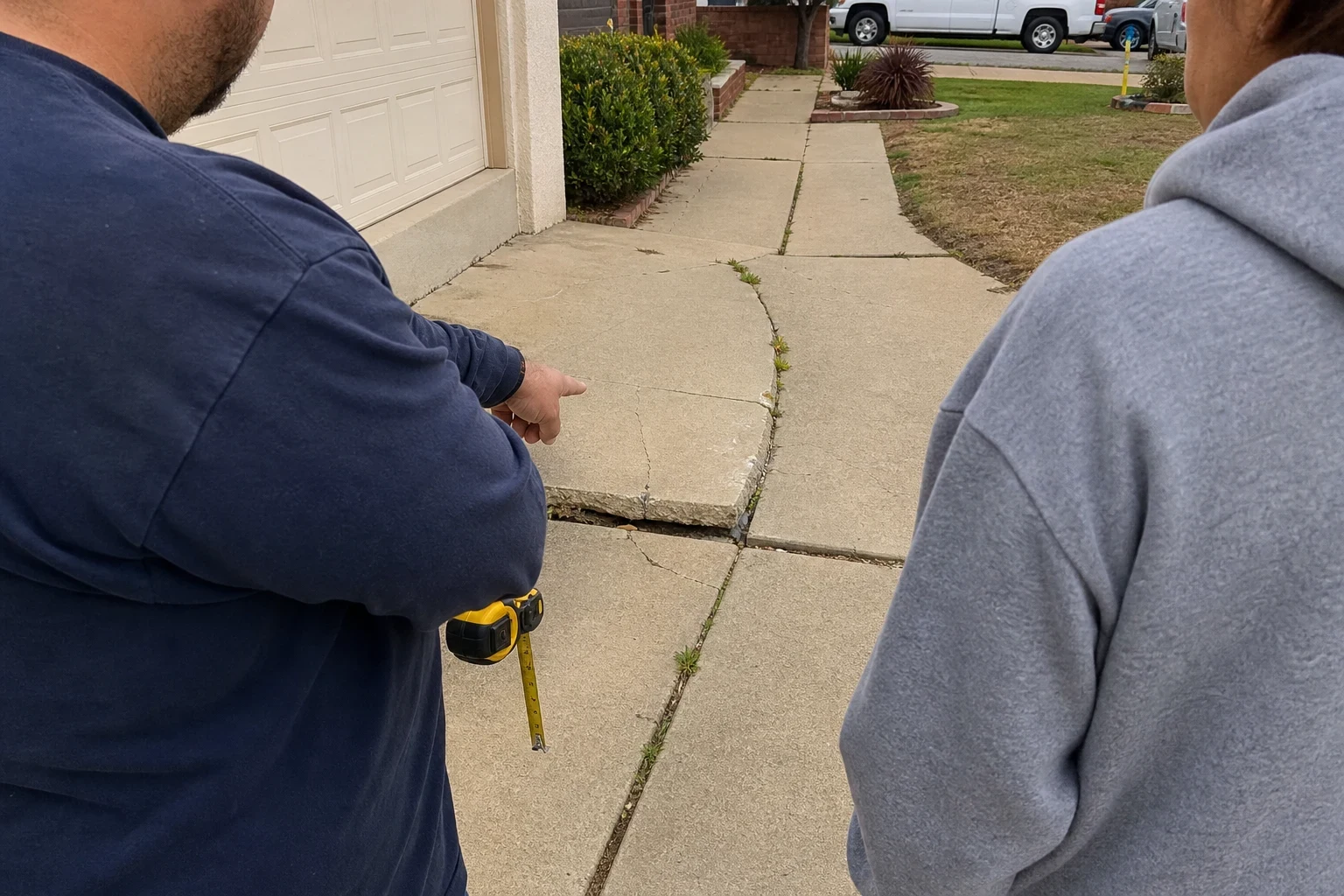
Popped tile and wide, offset cracks usually trace back to movement in the soil below. Replacing the slab lets us correct the base and drainage at the same time.
What moves the cost of a courtyard
Courtyard pricing depends less on square footage than on what it takes to reach the space and move water out of it. We price each part on the estimate so you can see where the cost comes from.
Access
A courtyard reached only through a gate or the house may need a line pump or extra labor to move concrete by hand. Open access costs less.
Removal of existing paving
Breaking out a thick old slab or mortar-set tile takes more time and haul-off than lifting sand-set pavers.
Drainage work
New area drains, a trench drain, or a fresh line out to the street add material and labor, especially where the line runs a long way.
Shape and finish
Curves around planters, fountains, and columns add forming time. Stamped patterns and integral color cost more than a broom or sand finish.
HOA review
If your HOA requires architectural approval, plan time for it. We can supply the measurements and finish details for your submission.
How the work runs
- 1
Site visit and measurements
We measure the courtyard, find the low points, check the weep screed height, and look at the access route. You get a written line-item estimate.
- 2
Demo, grade, and drains
Old material comes out, the base goes in, and drain lines are set and tested with water before any concrete is ordered.
- 3
Forming and pour day
Forms and steel are checked for grade, then the concrete is placed, screeded, floated, and finished. We protect walls, doors, and plants with plastic and cleanup happens the same day.
- 4
Curing and the check-back
Keep foot traffic off for about 24 to 48 hours and furniture off for about a week. Once the slab has cured, we return to look at the joints and drainage with you and explain sealing and cleaning.
Courtyard questions we hear
How do you get concrete into a courtyard with no truck access?
Usually with a line pump that runs a hose through a side gate or passage. For small courtyards we sometimes move the mix by wheelbarrow. We decide this at the site visit so it is already in your estimate.
Will my new courtyard crack?
Concrete shrinks as it cures, so fine hairline cracks are possible. Control joints at the right spacing give that movement a planned place to go, and a compacted base and rebar keep cracks from opening or offsetting.
Can you connect to the drains I already have?
Often, yes. We run water through the existing lines first. If a line is crushed or clogged with roots, we tell you and price a new run so the new slab is not draining into a dead end.
How do I take care of the slab afterward?
Rinse it and use a mild detergent for spills. Keep metal furniture feet and fertilizer off the surface to avoid rust stains. Decorative and colored concrete is usually sealed after about 28 days and resealed every few years; we go over the details at the check-back visit.
What happens at the follow-up visit?
We look at every joint, check that the drains take water, and point out any hairline cracks. You can ask questions about sealing, cleaning, and when to set heavy planters.
Plan a courtyard that sheds water
Tell us about your courtyard, how it's reached, and where water collects now. We'll set up a visit to measure and walk the drainage with you.